Insomnia Without Pills: Proven CBT-I Techniques That Actually Work
 Jan, 7 2026
For millions of people, lying awake at 3 a.m. isn’t just frustrating-it’s exhausting. You’ve tried melatonin, chamomile tea, white noise machines, and even sleeping pills. But the moment you stop the pills, the insomnia comes back. What if the real fix isn’t another pill, but a shift in how you think about sleep-and how you behave in bed?
Why Pills Don’t Solve Insomnia Long-Term
Sleeping pills might help you fall asleep the first night. But after a few weeks, your body builds tolerance. You need more. Then you worry about dependence. Then you feel groggy in the morning. And when you finally quit? Insomnia often returns worse than before. That’s not your fault. It’s how the drugs work. They don’t fix the root problem-they mask it. Meanwhile, your brain keeps learning that bed = anxiety = wakefulness. Enter CBT-I: Cognitive Behavioral Therapy for Insomnia. It’s not a trend. It’s not a hack. It’s the first-line treatment recommended by the American College of Physicians for chronic insomnia. And unlike pills, its effects last long after treatment ends.What Is CBT-I, Really?
CBT-I isn’t one trick. It’s a structured, evidence-based program that targets the thoughts and habits keeping you awake. Developed over decades by sleep researchers like Dr. Arthur Spielman and Dr. Jack Edinger, it’s backed by over 20 clinical trials showing it works as well as-or better than-medication. And here’s the kicker: it doesn’t require drugs. No prescriptions. No side effects. Just your commitment to changing a few patterns. Studies show CBT-I reduces the time it takes to fall asleep by about 19 minutes and cuts nighttime wake-ups by 26 minutes on average. After six months, 76% of people using digital CBT-I still report better sleep. That’s not luck. That’s science.The Five Core Techniques of CBT-I
CBT-I is made up of five key tools. You don’t need all five at once, but most people benefit from using at least three.1. Stimulus Control Therapy: Rebuild the Bed-Sleep Connection
Your brain has learned that bed = wakefulness. Stimulus Control breaks that link. Here’s how it works:- Only go to bed when you’re sleepy-not tired, not bored, not because it’s “time.”
- If you can’t fall asleep within 20 minutes, get out of bed. Go to another room. Do something quiet and dimly lit-read a book, listen to calm music. No phones.
- Return to bed only when sleepy again.
- Repeat this every time you can’t sleep.
- Get up at the same time every day, no matter how little you slept. Even on weekends.
2. Sleep Restriction: Less Time in Bed = Deeper Sleep
This is the hardest part. And the most powerful. Sleep restriction doesn’t mean you’re sleep-deprived on purpose. It means you’re matching your time in bed to your actual sleep. Let’s say you spend 8 hours in bed but only sleep 5.5 hours. Your sleep efficiency is 69%. That’s low. Healthy sleep efficiency is 85% or higher. So you cut your time in bed to 5.5 hours. You go to bed at 1 a.m. and wake up at 6:30 a.m. Even if you’re exhausted. Even if you think you’ll die. For the first 3-7 days, you’ll feel awful. That’s normal. Your body is building up sleep pressure-the biological drive to sleep. After a week, you’ll start falling asleep faster. You’ll wake up less. Your sleep becomes deeper, more consolidated. Then, once your sleep efficiency hits 85% for a week, you add 15 minutes to your time in bed. Keep doing this until you’re sleeping 7-7.5 hours without lying awake.3. Cognitive Restructuring: Stop the Sleep Catastrophizing
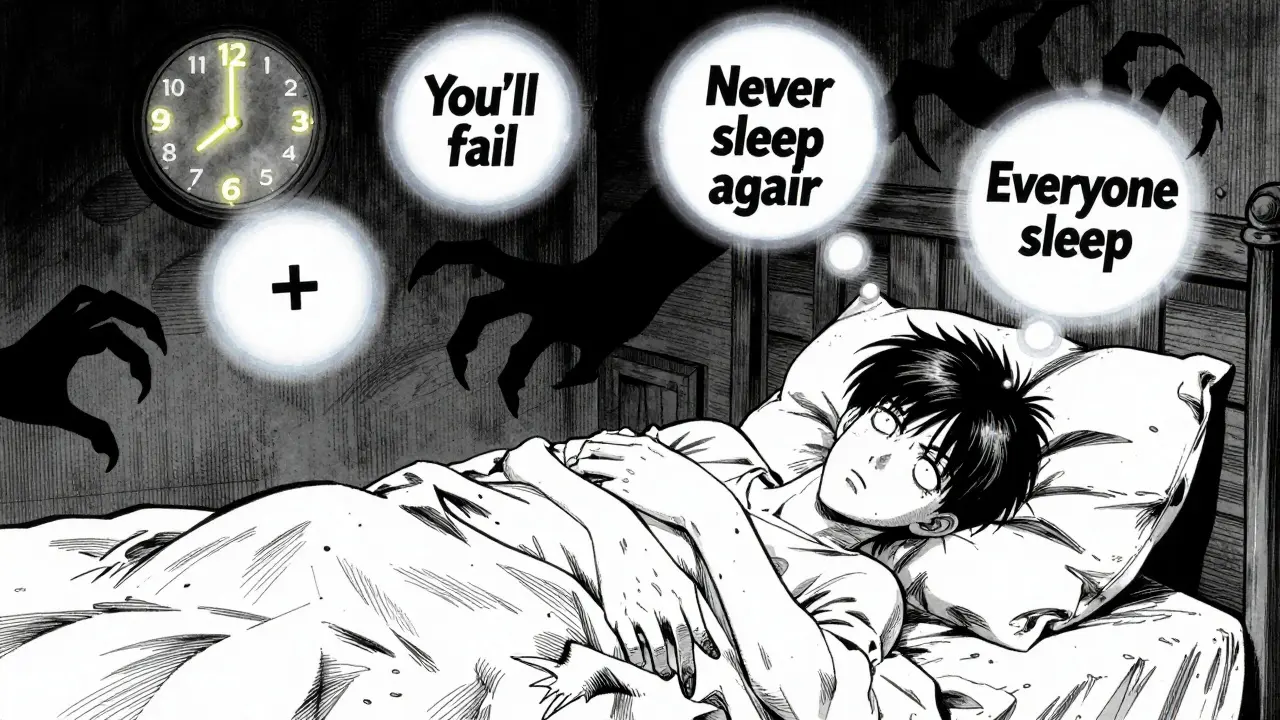
You tell yourself: “If I don’t sleep 8 hours, I’ll fail at work tomorrow.” “You’ll be useless.” “Everyone else sleeps fine-why can’t I?” These thoughts aren’t just annoying. They’re fueling your insomnia. Cognitive restructuring teaches you to challenge them. Replace “I’ll be useless” with “I’ve functioned on 4 hours before. I’ll manage.” Replace “I’ll never sleep again” with “This is a phase. My body knows how to sleep.” Keep a thought journal. Write down your sleep-related worries. Then write a more realistic, less fearful version. Over time, your brain stops believing the worst-case scenarios.4. Sleep Hygiene: Fix the Obvious, But Don’t Overdo It
You’ve heard this before: no caffeine after 2 p.m. No screens before bed. Keep your room cool. That’s all true. But here’s the catch: most people treat sleep hygiene like a checklist. “I didn’t drink coffee. I turned off my phone. Why am I still awake?” Sleep hygiene alone doesn’t fix insomnia. It supports CBT-I. But if you’re lying in bed for 2 hours because you’re afraid of caffeine, you’re reinforcing the problem. Focus on the big two: avoid alcohol before bed (it fragments sleep), and get morning sunlight. Just 15-20 minutes outside in the morning resets your circadian rhythm better than any supplement.5. Relaxation Training: Calm the Nervous System
Anxiety keeps your body in fight-or-flight mode. That’s the enemy of sleep. Progressive muscle relaxation (PMR) works wonders. Lie down. Tense each muscle group for 5 seconds-feet, calves, thighs, stomach, fists, shoulders, face-then release. Feel the difference. Diaphragmatic breathing helps too. Breathe in through your nose for 4 seconds, hold for 4, exhale through your mouth for 6. Repeat 5 times. This signals your nervous system: “We’re safe. You can shut down.” Do this not when you’re already awake at 3 a.m.-do it 30 minutes before bed. Make it part of your wind-down routine.
How Long Until I See Results?
Most people start noticing changes in 2-3 weeks. But the first week? It’s rough. Sleep restriction makes you tired. Stimulus control feels unnatural. You’ll doubt it’s working. That’s normal. In clinical trials, 25% of people almost quit during the first two weeks because they thought it wasn’t helping. But those who stuck with it? 80% saw major improvement by week 6. Track your sleep. Use a simple diary: bedtime, wake time, time to fall asleep, number of awakenings. Calculate sleep efficiency: (total sleep time ÷ time in bed) × 100. Aim for 85%. You don’t need an app. A notebook works. The act of tracking alone helps you see patterns you never noticed.Digital CBT-I: A Real Alternative to In-Person Therapy
Finding a trained CBT-I therapist is hard. There are only about 1,500 certified specialists in the U.S. for 330 million people. That’s why digital CBT-I platforms like Sleepio and CBT-i Coach have exploded in popularity. They deliver the same protocol-step by step-through apps or websites. A 2023 JAMA study tracked over 1,200 people using digital CBT-I. At six months, 76% still had better sleep. That’s higher than the 63% who used medication alone. And yes-Medicare and 85% of private insurers now cover digital CBT-I. Check with your provider. It might be free or low-cost.Who Benefits Most From CBT-I?
Everyone with chronic insomnia does. But it’s especially powerful for:- People who can’t take sleep meds (pregnant, elderly, those with liver issues)
- Adolescents (a 2024 study found CBT-I more effective than pills for teens)
- People with PTSD, cancer, or chronic pain
- Anyone who’s tried pills and wants to stop

What to Avoid
Don’t nap during the day. Even 20 minutes disrupts your sleep drive. Don’t check the clock. Seeing 3:17 a.m. triggers panic. Turn your clock away. Don’t compare your sleep to others. Your body doesn’t need 8 hours. Many healthy adults sleep 6.5. Don’t expect perfection. Some nights will be worse. That’s okay. Progress isn’t linear.Final Thought: Sleep Isn’t Something You Force
You can’t force sleep. You can only create the conditions for it. CBT-I doesn’t make you sleepy. It removes the barriers that keep sleep away. It’s not about trying harder. It’s about stopping the things that are working against you. If you’ve been stuck in the pill cycle-this is your way out. It takes work. But the payoff? Quiet nights. Clear mornings. And sleep that lasts.Can CBT-I really work without medication?
Yes. Multiple studies show CBT-I is as effective as sleep medication for improving sleep onset and reducing nighttime wake-ups-but without the side effects or risk of dependence. In fact, its benefits grow over time, while medication effects fade after stopping.
How long does CBT-I take to work?
Most people see noticeable improvements in 2-3 weeks. The first week is often the hardest, especially with sleep restriction, which can cause temporary fatigue. But by week 6, 70-80% of users report significant sleep improvement.
Is digital CBT-I as good as seeing a therapist?
Yes. A 2023 JAMA study found digital CBT-I had a 77.3% response rate at one month-nearly identical to in-person therapy. Many platforms offer personalized feedback, sleep tracking, and step-by-step guidance that’s just as effective.
What if I can’t stick to the schedule on weekends?
Waking up within 30 minutes of your usual time-even on weekends-is one of the most important rules. Sleeping in disrupts your circadian rhythm and undoes progress. If weekends are tough, start by shifting your bedtime earlier instead of sleeping in later.
Do I need to track my sleep?
Yes, at least for the first few weeks. Tracking helps you see patterns, measure progress, and adjust your time in bed accurately. You don’t need fancy apps-a notebook with bedtime, wake time, and sleep duration works fine.
Can CBT-I help if I have chronic pain or anxiety?
Absolutely. CBT-I is recommended for people with PTSD, cancer, chronic pain, and other conditions where sleep meds are risky or ineffective. It targets the sleep-specific behaviors and thoughts that worsen insomnia-even when other health issues are present.
Annette Robinson
January 7, 2026 AT 19:28I tried CBT-I after years of sleeping pills, and honestly? It saved my life. The first week was brutal-I felt like a zombie. But by week three, I was falling asleep faster than I had in years. No more 3 a.m. panic. No more dread of bedtime. It’s not magic. It’s just… smart.
Stimulus control was the hardest, but also the most transformative. Getting out of bed when I couldn’t sleep felt ridiculous at first. Turns out, my brain needed to unlearn that bed = anxiety.
Now I sleep 7 hours straight. No pills. No guilt. Just quiet nights. If you’re stuck in the pill cycle-just try one technique. Start with fixed wake time. You’ve got nothing to lose.
Luke Crump
January 9, 2026 AT 01:16Oh wow. Another ‘science says’ sermon on sleep. Let me guess-next you’ll tell me gravity is real and the Earth isn’t flat? CBT-I is just behavioral conditioning wrapped in academic jargon. You’re not ‘retraining your brain,’ you’re just punishing yourself into exhaustion.
What about the people who *can’t* get out of bed at 3 a.m.? What about the ones with chronic pain? Or trauma? Or a job that demands 3 a.m. shifts? This isn’t a cure-it’s a privilege for people who can afford to sleep on a schedule.
And don’t get me started on ‘digital CBT-I.’ You’re telling me an app can fix what decades of neuroscience can’t? Please. Sleep is a mystery. We don’t understand it. Stop pretending we do.
Molly Silvernale
January 9, 2026 AT 23:50CBT-I isn’t a technique-it’s a revolution. A quiet, unassuming, deeply human rebellion against the pharmaceutical industrial complex that’s convinced us we need chemicals to rest.
Think about it: we’ve been sold the lie that sleep is a problem to be solved, not a state to be invited.
Stimulus control? It’s not about discipline-it’s about reverence. You’re not forcing sleep-you’re making space for it. Like tending a garden. You don’t yell at the seeds to grow. You water them. You protect them. You wait.
And sleep restriction? That’s not deprivation-it’s surrender. You stop fighting your body. You let it build pressure. You let it crave. And when it finally collapses into sleep? It’s not because you tried harder. It’s because you finally stopped trying.
I used to count sheep. Now I count breaths. And the silence? It’s the most beautiful thing I’ve ever known.
Also-morning sunlight. Just 15 minutes. No sunglasses. No excuses. Your circadian rhythm isn’t a suggestion. It’s a covenant.
And yes. It works. Not because of science. Because of surrender.
Try it. Not to fix yourself. To remember who you were before you forgot how to rest.
Kristina Felixita
January 10, 2026 AT 06:21OMG I LOVE THIS SO MUCH I’VE BEEN TRYING TO TELL MY FRIENDS ABOUT CBT-I FOR YEARS AND NOBODY LISTENS
so i did sleep restriction for 3 weeks and yeah i was a zombie but like… by week 4 i started falling asleep in 10 minutes instead of 2 hours and i haven’t taken a pill in 6 months and i’m not even kidding i cried the first time i woke up naturally at 7am
also the clock thing?? game changer. turned mine to the wall and now i dont even know what time it is when i wake up and it’s so peaceful
and yes i used the va’s cbt-i coach app it’s free and it talks to you like a chill aunt who’s been there
you dont need to be perfect. just consistent. even if you mess up on the weekend. just get up within 30 mins. that’s it. you got this.
ps: no more naps. i know it hurts. but trust me. your body will thank you.
Joanna Brancewicz
January 10, 2026 AT 21:13CBT-I. First-line. Evidence-based. Non-pharmacological. Sustainable. High efficacy. Low relapse. Cost-effective. Scalable. Accessible via digital platforms. FDA-cleared apps. Medicare-covered. 76% retention at 6 months. No side effects. No dependence. No grogginess. No tolerance. No withdrawal.
Why aren’t we screaming this from rooftops?
Evan Smith
January 11, 2026 AT 07:35Okay so I tried this for a week and I’m not gonna lie-I thought I was gonna die. But then I realized… I wasn’t dying. I was just tired. And that’s okay.
My wife laughed when I got out of bed at 2 a.m. to read a book. I laughed back because I finally understood: I wasn’t failing at sleep. I was failing at *expecting* sleep.
Also, I turned my clock around. Best decision ever. I don’t know what time it is anymore. And honestly? I don’t care.
Still not sleeping 8 hours. But I’m not panicking either. Progress, not perfection.
Also-morning sunlight? I’m now the guy who walks his dog at 7 a.m. like a wellness influencer. I don’t care. I sleep better.
Lois Li
January 11, 2026 AT 15:25I’ve been living with chronic insomnia for 12 years. I’ve tried everything: melatonin, valerian, weighted blankets, sleep trackers, white noise machines, hypnosis apps, acupuncture, even a $1,200 ‘sleep optimization’ retreat.
None of it stuck.
CBT-I was the first thing that didn’t make me feel broken. It didn’t ask me to fix myself-it asked me to stop sabotaging myself.
Stimulus control felt impossible. Sleep restriction felt cruel. But I did it anyway. And slowly, the panic around sleep began to fade.
I still have bad nights. But now I don’t fear them. I know they’re just part of the rhythm.
This isn’t about being perfect. It’s about being patient. And kind-to yourself.
If you’re reading this and you’re tired… you’re not alone. And you don’t need a pill to rest. You just need a little space to try again.
christy lianto
January 12, 2026 AT 15:54STOP WASTING TIME. If you’re still reading this and haven’t started CBT-I, you’re choosing suffering. Not because you’re weak. Because you’re scared.
Here’s the truth: you don’t need more sleep. You need less fear.
Sleep restriction isn’t torture-it’s a reset. You’re not losing sleep. You’re reclaiming it.
And yes-it’s hard. The first week? You’ll hate it. You’ll want to quit. You’ll think you’re going insane.
Good.
That’s your brain screaming because it’s finally being forced to unlearn its lies.
Do it anyway.
Track it. Stick to your wake time. No naps. No clocks. No excuses.
You think you’re tired? You’re not. You’re addicted to the drama of insomnia.
Break the cycle. Now. Before another year slips away.
I did it. You can too.
Ken Porter
January 12, 2026 AT 22:58Why are we letting apps tell us how to sleep? This is just another Silicon Valley scam. People used to sleep fine before they invented ‘sleep hygiene.’
Back in my day, we just closed our eyes and went to bed. No tracking. No apps. No ‘sleep efficiency.’
Now we’ve turned rest into a productivity metric. Pathetic.
Also, ‘digital CBT-I’? That’s just a fancy way of saying ‘pay $20/month to hear a robot tell you to stop checking your phone.’
Go outside. Walk. Breathe. Stop overthinking. Sleep will come.
swati Thounaojam
January 14, 2026 AT 11:00i tried cbt-i after 5 years of no sleep. it was hard. but i did it. now i sleep 6 hours. not 8. but i dont care. i feel human again.
no pills. no guilt. just quiet.
thank you for sharing this.
Manish Kumar
January 16, 2026 AT 04:55Let’s be honest: CBT-I is just a modern reincarnation of Stoic philosophy applied to sleep. The ancient Greeks didn’t need apps or sleep trackers-they understood that suffering arises from attachment to outcomes. You’re not trying to sleep. You’re trying to control sleep. And that’s the problem.
The moment you stop trying to force sleep, it arrives. Not because you did everything right, but because you stopped resisting.
Stimulus control? That’s the Zen of sleep. Bed is not a battlefield. It’s a sanctuary.
Sleep restriction? That’s the Taoist principle of wu wei-non-action. You don’t push. You allow. You build pressure. You wait. And then, like a river finding its course, sleep flows.
The real miracle isn’t the technique. It’s the surrender.
And yes-you don’t need to be perfect. You just need to be present.
So stop reading about sleep. Start living it.
Aubrey Mallory
January 16, 2026 AT 09:21Ken, you’re not helping. This isn’t about ‘back in my day.’ It’s about science. And evidence. And people who are suffering.
CBT-I isn’t a ‘scam.’ It’s the most effective treatment we have for chronic insomnia. Period.
And yes-digital platforms are accessible. They’re free. They’re covered by insurance. You can’t dismiss them because they’re not ‘old-school.’
People are dying from sleep deprivation. Not metaphorically. Literally. High blood pressure. Heart disease. Depression. Suicide.
So if you want to romanticize ‘just closing your eyes,’ fine. But don’t tell people who are struggling that they’re weak for trying to fix it.
There’s dignity in seeking help. Even if it comes from an app.
Dave Old-Wolf
January 18, 2026 AT 06:36I’ve been using CBT-I for 4 months now. I started with sleep restriction. I thought I’d die. I didn’t. I survived. Then I got better.
Now I’m on the ‘relapse’ phase. Had a bad week last week. Stayed up till 4 a.m. Three times.
But here’s the thing-I didn’t panic. I didn’t take a pill. I didn’t beat myself up.
I just went back to my routine. Fixed wake time. No clock. Got out of bed after 20 minutes.
And guess what? I’m back on track.
So if you’re thinking of giving up? Don’t.
It’s not about never having a bad night.
It’s about never letting a bad night break you.
Annette Robinson
January 19, 2026 AT 04:11Thank you for saying that. I had the same thing last month. Thought I’d ruined everything. Turned out? I just needed a reset.
CBT-I isn’t linear. It’s spiral. You circle back. But each time, you’re a little stronger.
And that’s the real win.