How Bioequivalence Studies Are Conducted: Step-by-Step Process
 Feb, 10 2026
When a pharmaceutical company wants to sell a generic version of a brand-name drug, they don’t have to run expensive clinical trials proving it works. Instead, they must prove bioequivalence-that the generic delivers the same amount of drug into the bloodstream at the same speed as the original. This isn’t just paperwork. It’s a tightly controlled scientific process that ensures patients get the same therapeutic effect, whether they take the brand or the copy. And if this step fails, the generic never hits the market.
Why Bioequivalence Matters
Every year, millions of people take generic drugs. In the U.S. alone, generics made up 90% of all prescriptions in 2023. But they’re not just cheaper-they have to be just as effective. That’s where bioequivalence studies come in. These studies compare how quickly and how completely a generic drug is absorbed into the body compared to the brand-name version, called the reference listed drug (RLD). The goal? To prove the two are therapeutically interchangeable.
The legal foundation for this came from the 1984 Hatch-Waxman Act in the U.S., which created the Abbreviated New Drug Application (ANDA) pathway. Before that, companies had to prove safety and efficacy from scratch. Now, they only need to show bioequivalence. Similar rules exist in Europe, Japan, Canada, and elsewhere. The FDA estimates that between 2010 and 2019, generic drugs saved the U.S. healthcare system $1.68 trillion. None of that would be possible without rigorous, standardized bioequivalence testing.
The Standard Study Design: Crossover
Most bioequivalence studies use a two-period, two-sequence crossover design. That sounds complicated, but here’s how it works in practice:
- 24 to 32 healthy volunteers (sometimes up to 100) are enrolled.
- Half get the generic drug first, then the brand-name drug after a washout period.
- The other half get the brand-name drug first, then the generic.
This design controls for individual differences. If one person naturally absorbs drugs faster than others, they’ll still be their own control. The washout period is critical-it must last at least five half-lives of the drug. For example, if a drug clears the body in 12 hours, volunteers wait at least 60 hours (five days) before switching. Otherwise, leftover drug from the first dose could mess up the second measurement.
For drugs with very high variability-like those where the same person’s absorption changes a lot from dose to dose-the study gets more complex. The EMA recommends a four-period replicate design, where each subject gets each product twice. This gives more data to accurately measure variability. The FDA allows a method called reference-scaled average bioequivalence (RSABE) for these cases, which adjusts the acceptance range based on how much the reference drug itself varies.
How Blood Samples Are Taken
After volunteers take the drug, researchers draw blood at specific times to measure how much of the drug is in their system. This isn’t random. There’s a strict sampling schedule based on pharmacokinetics-the science of how the body handles the drug.
At least seven blood samples are taken:
- Before dosing (time zero).
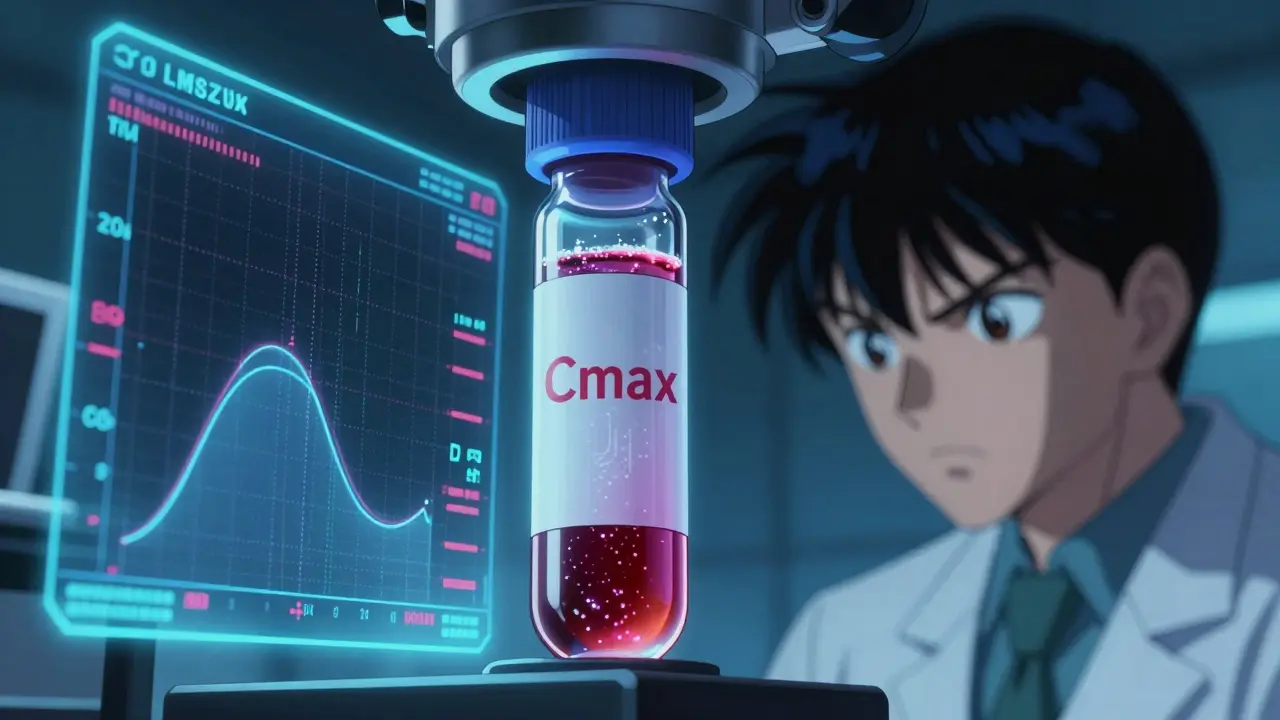
- One sample just before the expected peak concentration (Cmax).
- Two samples around the peak.
- Three samples during the elimination phase.
The last sample must capture at least 80% of the total drug exposure (AUC∞). For many drugs, that means sampling for 3 to 5 half-lives-sometimes up to 72 hours or longer. A drug with a 72-hour half-life? You’re looking at a 10-day study. One CRO reported a study failure because they only sampled for 48 hours on a drug with a 72-hour half-life. The result? $250,000 lost and three months delayed.
Plasma or serum is the standard sample type. The lab uses a technique called LC-MS/MS (liquid chromatography-tandem mass spectrometry) to detect tiny amounts of the drug. This method must be validated to be accurate within ±15% (±20% at the lowest detectable level). If the lab’s method isn’t good enough, the whole study can be rejected.
What Gets Measured
Two key numbers determine whether the generic passes:
- Cmax-the highest concentration of the drug in the blood.
- AUC(0-t)-the total drug exposure from time zero to the last measurable point.
AUC(0-∞) is also used if the last sample captures enough of the drug’s elimination. These values are logged for each subject, for each drug, in each period.
The data is then transformed using logarithms because drug concentrations are not normally distributed-they follow a log-normal pattern. After transformation, researchers run a statistical analysis called ANOVA (analysis of variance), with factors for sequence, period, treatment, and subject.
The result? A 90% confidence interval for the ratio of test (generic) to reference (brand) drug. For most drugs, the CI must fall between 80.00% and 125.00% for both Cmax and AUC. That means the generic can’t deliver more than 25% more or less than the brand. For drugs with a narrow therapeutic index-like warfarin or levothyroxine-the range tightens to 90.00%-111.11%.
When Other Methods Are Used
Not all drugs can be studied with blood samples. For some, the effect is what matters-not the concentration.
- Pharmacodynamic studies measure the drug’s effect, like how much a blood thinner reduces clotting time.
- Clinical endpoint studies look at actual health outcomes-for example, whether a topical cream reduces eczema symptoms better than another.
- In vitro dissolution testing is used for certain drugs (BCS Class I) that dissolve easily and are absorbed consistently. If the generic dissolves at the same rate as the brand across different pH levels, regulators may approve it without a human study.
According to FDA data from 2022, 95% of all bioequivalence submissions used pharmacokinetic (blood) studies. The rest relied on one of these alternatives.
What Makes or Breaks a Study
Even small mistakes can sink a study. The FDA’s 2022 Bioequivalence Study Tips report breaks down the top failures:
- 45% fail due to inadequate washout periods.
- 30% fail because sampling times were off.
- 25% fail because of statistical errors.
Other common problems:
- Using the wrong reference product batch.
- Not testing enough units for dissolution comparison.
- Using unvalidated lab methods.
One bioanalytical lab reported that 22% of studies they worked on faced delays because of assay problems-costing an average of $187,000 per delay. That’s why pilot studies are now standard. Experienced CROs run small-scale tests first to catch issues before the main study. According to a 2022 survey of 127 CROs, 89% of successful studies included a pilot.
Regulatory Differences Around the World
While most countries follow similar rules, there are key differences:
- U.S. FDA: Allows RSABE for highly variable drugs. Accepts BCS-based waivers for certain drugs.
- EMA (Europe): Requires replicate designs for highly variable drugs. No RSABE.
- PMDA (Japan): Requires additional dissolution testing even for some BCS Class I drugs.
These differences mean a generic approved in the U.S. might not automatically be approved in Japan or Europe. Companies often run separate studies to meet each region’s requirements.
Real-World Outcomes
Most studies succeed. In 2022, the FDA approved 936 generic drugs based on bioequivalence data-98% of all generic approvals that year. Teva’s generic version of Januvio (sitagliptin) was approved after a single successful study with 36 subjects. But failures happen too. Alembic Pharmaceuticals’ attempt to launch a generic of Trulicity (dulaglutide) was rejected in 2022 because Cmax values varied too much across studies.
What’s next? The FDA is exploring ways to reduce study requirements using modeling and simulation. In 2023, they released a draft guidance covering 1,500 drug substances. They’re also expanding use of real-world evidence. But for now, the blood draw, the sampling schedule, and the 80%-125% rule remain the gold standard.
What You Need to Know
If you’re a patient, you don’t need to understand the math. But you should know this: when your pharmacist gives you a generic, it’s been tested in a controlled study with real people, precise measurements, and strict statistical rules. It’s not a guess. It’s science.
If you work in pharma, the lesson is simple: don’t cut corners. Pilot studies, validated methods, and precise timing aren’t optional. They’re the difference between approval and rejection.
What is the main goal of a bioequivalence study?
The main goal is to prove that a generic drug delivers the same amount of active ingredient into the bloodstream at the same rate as the brand-name drug. This ensures the two products are therapeutically interchangeable, meaning they produce the same clinical effect and safety profile.
Why do bioequivalence studies use healthy volunteers?
Healthy volunteers are used because they have no underlying diseases or medications that could interfere with how the drug is absorbed, metabolized, or eliminated. This allows researchers to isolate the effect of the drug formulation itself, rather than patient-specific factors.
What happens if a bioequivalence study fails?
If the 90% confidence interval for Cmax or AUC falls outside the 80%-125% range, the study is considered a failure. The company must either redesign the formulation, improve the manufacturing process, or run a new study. This can cost millions and delay market entry by months or years.
Can a generic drug be approved without a human study?
Yes, for certain drugs classified as BCS Class I (highly soluble and highly permeable), regulators like the FDA may approve them based on in vitro dissolution testing alone. This is called a biowaiver. However, this only applies to simple, rapidly absorbed drugs and not to modified-release or complex formulations.
How long does a typical bioequivalence study take?
A standard two-period crossover study takes about 4 to 8 weeks from screening to final sample collection. The actual time each subject spends in the clinic is usually 1 to 3 weeks, depending on the drug’s half-life. Longer half-lives mean longer studies-sometimes over 10 days per period.
Are bioequivalence studies the same worldwide?
No. While most countries follow similar principles, regulatory agencies have different rules. For example, the FDA allows reference-scaled bioequivalence for highly variable drugs, while the EMA requires replicate designs. Japan has stricter dissolution requirements. Companies often run region-specific studies to meet local requirements.
Brad Ralph
February 11, 2026 AT 07:01Still blows my mind that we can save billions and nobody freaks out about it. Just another day in capitalism.
Craig Staszak
February 13, 2026 AT 00:58alex clo
February 13, 2026 AT 06:04Carla McKinney
February 14, 2026 AT 04:13Ojus Save
February 15, 2026 AT 12:18Sonja Stoces
February 16, 2026 AT 12:36Luke Trouten
February 16, 2026 AT 16:23Gabriella Adams
February 17, 2026 AT 13:46